Quick answer: An access control system for small business replaces or supplements keys with PIN codes, key cards, fobs or phone credentials. It lets you add or remove employees in seconds, see who entered and when, and lock doors on a schedule. For most Tucson shops and offices, a keypad or card system on the main entry is the best starting point. Call Locksmith Near Me at (520) 214-5315 for a free on-site recommendation.
Keys worked fine when you had two employees. But as your team grows, keys get lost, copied and passed around, and every staff change means another rekey. That is why more Tucson owners are asking about an access control system for small business: a practical way to control who gets in, when, and through which door.
This 2026 guide explains the main types of systems, what features actually matter for a small operation, how installation works and how to choose the right setup for your budget. Our team installs and services keyless access control for retail stores, restaurants, medical and dental offices, salons, warehouses and professional offices across Tucson.
What Is an Access Control System?
An access control system is made of four basic parts:
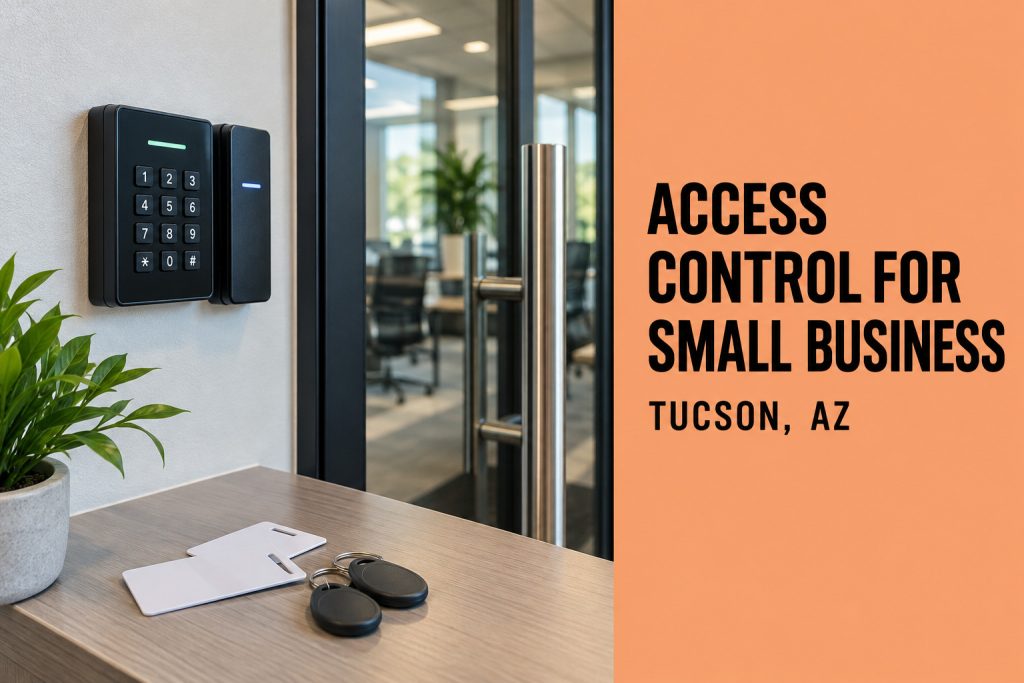
- Credentials: what a person uses to get in, such as a PIN, a key card, a key fob or a smartphone app.
- Readers: the keypad or card reader mounted next to the door.
- Locking hardware: an electric strike, magnetic lock, electrified lever or electrified exit device that releases when access is granted.
- Controller and software: the brain that decides who can enter, stores schedules and records every event.
Small systems can be as simple as a single standalone keypad lock. Larger systems connect several doors to cloud software you manage from a phone or laptop.
Why an Access Control System for Small Business Makes Sense
Owners usually make the switch for one of these reasons:
- Instant changes: When an employee leaves, you delete their credential instead of paying for a rekey.
- Accountability: Audit logs show which credential opened which door and when.
- Schedules: Doors can unlock at opening time and lock at closing automatically.
- Restricted areas: Staff can open the front door but not the office, cash room or pharmacy storage.
- Remote management: Let in a delivery driver or cleaner from your phone.
Comparing Your Options in 2026
There is no single best access control system for small business. The right choice depends on how many doors you have, how many people need access and how much you want to manage remotely.
| System Type | Best For | Management |
|---|---|---|
| Standalone keypad lock | 1–2 doors, small teams | At the lock |
| Card or fob system | Retail, clinics, offices | On-site or cloud |
| Cloud-based system | Multiple doors or sites | Phone or web app |
| Mobile credentials | Tech-friendly teams | Phone app |
Standalone Keypad Locks
The simplest and most affordable option. Each lock stores its own codes. Great for a salon, small office or back door. The downside is that changes must be made at each lock and there is limited reporting. See our guide to smart lock installation for Tucson businesses for popular models.
Card and Fob Systems
Employees carry a card or fob. Lost cards are deactivated in seconds. These systems scale well and are a common choice for medical offices and retail stores.
Cloud-Based Systems
Cloud platforms let you manage every door from anywhere, set schedules and receive alerts. They are ideal if you have more than one location or you are often away from the business.
Mobile Credentials
Employees use their phone to open the door. There are no cards to lose, and credentials can be issued remotely. Many cloud systems support both cards and phones.
Not Sure Which System Fits Your Business?
We visit your location, review every door and recommend an access control setup that fits your team and budget.
Features That Matter Most for Small Businesses
- Easy user management: Adding and removing staff should take less than a minute.
- Battery or power backup: Doors must stay secure during a power outage, which is important during monsoon storms.
- Fail-safe or fail-secure options: Choose the correct behavior for each door based on code and security needs.
- Mechanical key override: A backup key cylinder in case of electronic failure.
- Audit trail: Clear logs you can export if something goes missing.
- Integration: Compatibility with alarms or cameras if you plan to add them later.
Code, Safety and Accessibility
Any access control system for small business must keep exits safe. People must be able to leave without a key, card or special knowledge, and electrified hardware must release as required by fire and building codes. Door hardware should also be usable by everyone; the ADA Standards for Accessible Design cover hardware height and operation. Our technicians plan each door with egress in mind and can pair access control with exit door panic bars where needed.
How Installation Works
- Site survey: We walk each door, check the frame, power access and traffic.
- Design: We recommend readers, locking hardware and software based on your goals.
- Installation: Hardware is mounted, wiring is run neatly and the controller is set up.
- Programming: We enroll your staff, set schedules and create access levels.
- Training: We show you how to add and remove users and read the logs.
Most single-door installations are finished in one day, and we schedule work around your business hours.
Access Control and Traditional Locks Work Together
Even the best access control system for small business needs strong mechanical hardware behind it. Storefront frames, strikes and cylinders still matter. For doors that stay on keys, such as a back storage room, we recommend high-security locks with restricted keys. Together, they give you layered security that is hard to beat.
Which Businesses Benefit the Most?
Almost any company with employees can gain from electronic access, but some see the payoff faster than others:
- Restaurants and bars: Early prep staff, late closers and delivery drivers all need different access at different times.
- Medical and dental offices: Patient records and medication storage call for restricted areas and a clear audit trail.
- Retail stores: Stockrooms and cash offices can be limited to managers while sales staff use the front door.
- Gyms and studios: Members or instructors can be given scheduled entry without handing out keys.
- Warehouses and contractors: Multiple shifts and frequent staff changes make key management expensive.
If your business has high turnover, several shifts or more than one location, an access control system for small business will usually pay for itself by cutting rekey costs and saving management time.
Questions to Ask Before You Buy
Before choosing a vendor, ask a few simple questions. Who owns the data and the account if you switch providers? Are there monthly fees, and what do they include? Can you add doors later without replacing the controller? What happens if the internet goes down? Is there local support in Tucson if a reader fails on a Saturday? The answers help you pick an access control system for small business that keeps working long after installation day.
What Affects the Cost
We always provide a clear, written quote. The cost depends on the number of doors, the type of reader and credential, the locking hardware each door needs, wiring and power requirements, software or cloud subscription fees and how many users you have. Starting with one or two key doors and adding more later is a smart way to control your budget. For an overview of all our business services, see our article on commercial locksmiths in Tucson.
Where We Serve
We design and install every type of access control system for small business owners in Tucson, including downtown, the University area, Midtown, the east side and the northwest, plus Casas Adobes, Oro Valley, Marana and Sahuarita.
Frequently Asked Questions About an Access Control System for Small Business
What is the best access control system for small business?
It depends on your doors and team size. Many small businesses start with a keypad or card system on the main entry and expand later.
How much does a small business access control system cost?
Cost depends on doors, hardware, wiring and software. We provide a written quote after a quick site visit.
Can I manage access from my phone?
Yes. Cloud-based systems let you add users, unlock doors and view logs from a phone or computer.
What happens during a power outage?
Most systems include battery backup, and doors can be set to fail-secure or fail-safe based on code requirements.
Can I keep my existing door hardware?
Often, yes. We can add an electric strike or electrified lever to many existing doors.
Is a keypad lock enough for a small office?
For one or two doors and a small team, a quality standalone keypad lock is often enough.
Can I restrict employees from certain rooms?
Yes. Access levels let you control which doors each person can open and at what times.
Do access control systems meet fire code?
When designed and installed correctly, yes. Exits must always allow free egress.
How long does installation take?
A single door is usually completed in one day. Larger projects are scheduled around your hours.
Who installs access control in Tucson?
Locksmith Near Me designs and installs access control for Tucson businesses. Call (520) 214-5315.
Ready to stop worrying about lost keys? Call Locksmith Near Me at (520) 214-5315 to plan the right access control system for small business needs like yours.